
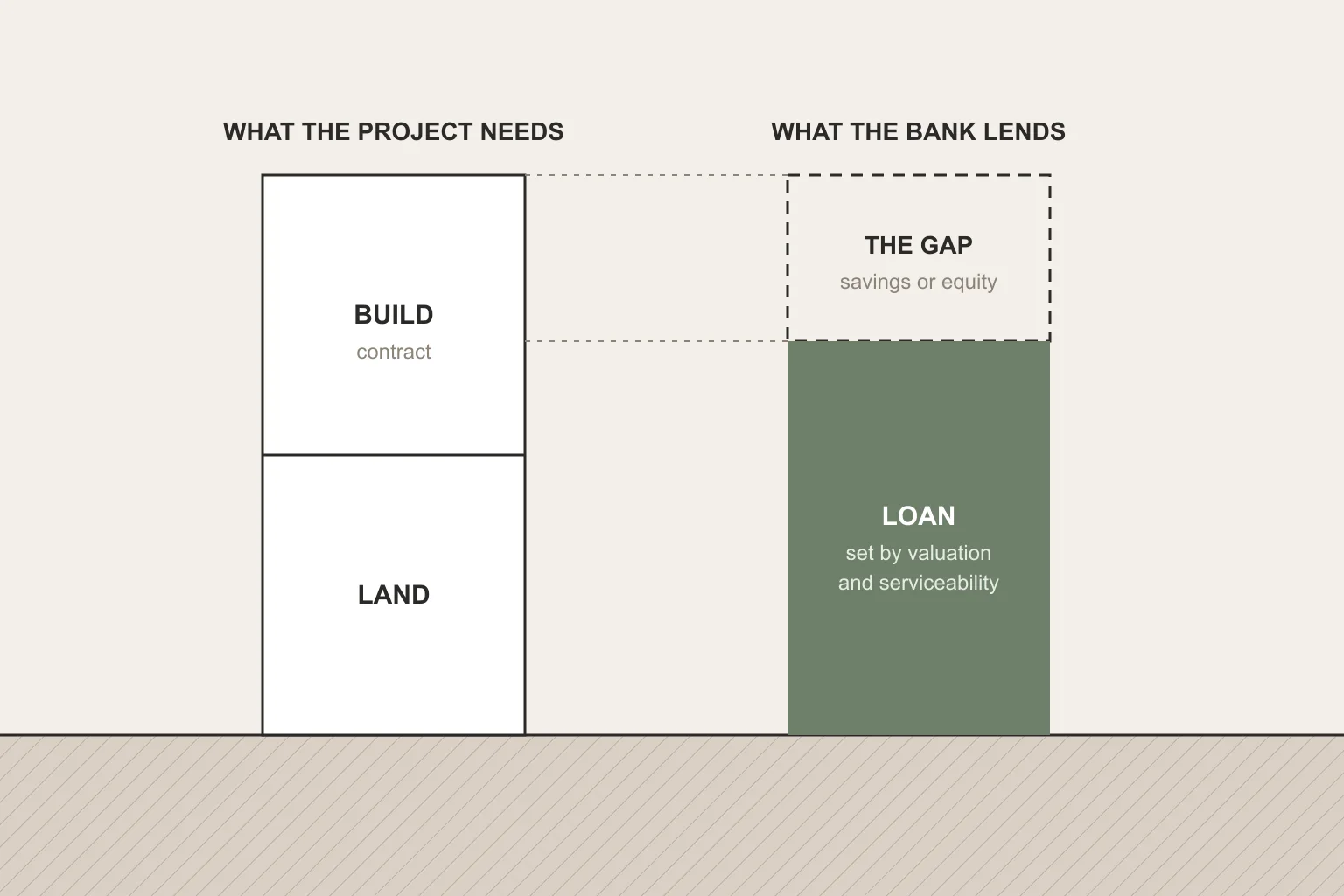
A construction loan pays your builder in stages as the house goes up, with interest charged only on the money drawn so far. How much the bank will lend rests on two tests. The first is whether you could keep up repayments at a rate well above the one you are offered. The second is what the bank's valuer thinks the finished home will be worth. Rate rises in 2026 have made the first test harder to pass, while falling values can pull the second down.
This is a builder's explanation, not financial advice. Your broker or lender has the final word.
How a construction loan works
As each stage is finished, your builder issues an invoice and the lender pays that stage from the loan. Lenders' own guides describe the same pattern: interest is charged only on what has been drawn, repayments are usually interest-only during the build and the loan switches to principal and interest at the end. If you are putting in money of your own, lenders generally have you spend it first, before their payments start.
How construction loan progress payments work in Victoria
Your building contract sets the stages and what is paid at each one. As each stage is finished, the lender pays it from the loan. Victorian law sets the ground rules. Under the Domestic Building Contracts Act 1995 the deposit on most new-home contracts is capped at 5% of the contract price. The Act also sets standard stages (base, frame, lock-up and fixing) with a maximum share of the price for each. The final payment isn't due until the work is finished and you have a copy of the occupancy permit.
A contract can use a different schedule. To do that, you sign a prescribed warning before you sign the contract. You and the builder also both sign a clause that sets out each stage and the amount due at it. The warning gives examples such as a steep or rocky site or a very large home that needs payments between the standard stages. Consumer Affairs Victoria recommends legal advice before you agree to a different schedule. From 31 March 2027, when the 2025 amendments are due to start, progress payments will have to be proportionate to the work completed.
We tailor our schedules to each project. These are the things that shape them:
- the contract value and the size of the project
- the scope of work and the order it is built in
- the site, including sloping blocks and more extensive foundation works
- what your lender requires
The schedule on any job depends on the contract, the project and the lender. Our guide to the custom home build process explains what each stage involves on site.
Valuations, progress inspections and quantity surveyor reports
These are three different checks. Lenders don't all use them the same way. The valuation comes first: before construction starts, the lender's valuer values the finished home from your plans, specification and contract, which sets how much the lender will lend. Some lenders call it a "to be erected" valuation. There is more on how it works further down.
Progress inspections happen during the build. Before releasing a stage payment, the lender may send its valuer to check that the stage is done. How often varies. Some lenders inspect only the first and final stages, some inspect every stage once a build is above a value threshold they set, some inspect at set points such as lock-up and some decide case by case. Your lender or broker can tell you which applies. Before the final payment, lenders usually arrange a final inspection or a full valuation and ask for proof of home insurance. Many also want the occupancy permit.
A quantity surveyor (QS) report is a closer check of the cost. A QS assesses the total build cost at the start and can then certify each stage and the cost to finish. Lenders ask for one on larger or less standard builds. One published trigger is a build above a value threshold the lender sets. Another is the valuer deciding one is needed, for example on a large or unusual architect-designed home. Where a QS is required, the report can be needed before the first payment and again with each claim. The borrower usually arranges and pays for it.
None of these checks the quality of the work. A lender's inspection is for the lender; checking workmanship is a job for an independent building inspector. Inspections can add a few business days to a payment. A significant variation can also mean a new valuation. Fees vary by lender, so ask your broker what applies to your loan. Where a lender's inspections or reports need extra site attendance or documents from us, we raise it at the start, because it can affect our pricing.
How much can you borrow to build a house?
Probably less than a year ago, if your income hasn't changed. Every APRA-regulated bank must check that you could still meet repayments at a rate at least 3 percentage points above the rate on your loan, a buffer APRA has held since 2021. The RBA lifted the cash rate in February, March, May and September 2026. Each rise your lender passes on lifts the rate it tests you against as well. Cotality makes the same point: higher mortgage rates reduce borrowing capacity.
One 2026 change works in your favour. APRA's limit on lending to borrowers with debt of six times their income or more, in force since 1 February 2026, excludes loans to build a new home. A pre-approval is still only a starting point. Moneysmart notes that the lender will assess you and the property again before final approval, so get your broker involved before you commit to land or sign a building contract. Working through what the bank will lend against the cost of the home is something our director goes through with many of the families who call us this year.
How the bank values a home that isn't built yet
Lenders order an "as if complete" valuation, sometimes called a valuation on completion. The valuer estimates what the land plus the proposed home will be worth once it is finished, working from your plans and contract. That figure sets the loan-to-value ratio. Some lenders value again during the build or require a full valuation before the final payment.
What happens if the construction loan valuation comes in low
You make up the difference or borrow less. When the valuation is lower than the land plus the build, the bank lends against the lower number. Lenders' own guides say you may need a bigger deposit or a smaller loan. They list existing equity, a larger deposit or a guarantor as ways to cover the gap. Borrowing more than 80% of the value usually means lenders mortgage insurance, which protects the lender, not you.
A falling market makes this more likely. Melbourne values dropped 6.2% over the twelve months to September 2026, by Cotality's count. A valuation can also move between the day you buy land and the day the loan settles. Cost overruns and variations that add to the price are usually yours to fund from your own money as well, since the lender pays only up to the valuation for each stage.
An illustration in percentages shows how quickly a gap opens. Call the land plus the build 100. If the valuation comes in at 95 and your lender will lend 80% of value, it lends 76 rather than 80, so you fund 24 points instead of 20. At that ratio every point of shortfall adds 0.8 of a point to what you put in.
Setting a realistic budget before design starts
The budget should shape the design, not the other way round. This is the order we work in with our clients:
- Work out your borrowing capacity and the funds you have available.
- Agree a realistic total budget for the whole project.
- Design the home and make selections around that budget.
- Review the costs as the design and inclusions develop.
We ask clients to share their actual budget, because without it we can't give useful advice on where the money should go. Some would rather have a larger home with simpler finishes. Others prefer a smaller home with a higher specification. We help you weigh up those choices before they are locked into drawings.
The design and approvals stage can take several months, so the finance assumptions and the conditions of your pre-approval need checking along the way. Moneysmart says a pre-approval usually lasts three to six months, so it can expire before the design is finished. The lender also reassesses you and the property before final approval.
Managing upgrades and budget changes
Clients often upgrade finishes and inclusions during design and selections. We keep you advised on what each decision does to the budget as you go. If the final scope ends up larger than the funds available, we look at changes to the design, the inclusions or the finishes. Sometimes we suggest leaving suitable items until after completion, provided that doesn't compromise the approvals, compliance or the essential works. The aim is that you make each decision knowing what it costs.
Keeping the budget and the bank in step
- Sign a fixed-price contract, which lenders expect. Some treat cost-plus contracts as an exception or lend less against them. Our guide to fixed price and cost-plus contracts covers the difference.
- Settle selections before the valuation, so the contract and the valuer are both working from the home you will actually build. Allowances that grow later fall on you.
- Get the site investigated early. A soil report and a feature and level survey let the site costs go into the contract price instead of turning up as variations.
- Keep a margin in cash, outside the loan, for anything the valuation doesn't cover.
- Ask your broker early what the lender will want. A signed fixed-price contract is standard.
Choosing a lender and working with them during the build
Your borrowing capacity is ultimately the lender's call. No one bank suits every client, so what matters is a lender that suits you and the way your home will be built. We can recommend a broker experienced in construction finance to look at the options with you.
The price for the custom homes we build is fixed once the design, the site investigations and the permits are settled. If your broker has questions about the contract, our director can answer them. For the bigger question of whether to build now, see our piece on building in a falling market. To talk about your block, get in touch.
Frequently Asked Questions
Do you pay interest on the whole construction loan from day one?
No. The major lenders charge interest only on the amount drawn so far. Repayments are usually interest-only while the house is being built. They switch to principal and interest once construction finishes. Check the terms of your own loan, because products differ.
What is an 'as if complete' valuation?
It is the bank's estimate of what your property will be worth once the house is finished, covering the land and the home in your plans and contract. Lenders use it to set how much they will lend. Some value again during the build, for example before the final payment.
Does the bank inspect every stage of the build?
Not always. Some lenders inspect only the first and final stages, some inspect every stage once a build is above a value threshold they set and some decide case by case. Larger or less standard builds can also need a quantity surveyor's report. These inspections are for the lender and don't check the quality of the work.
How much deposit do I need for a construction loan?
That depends on the lender and on how much of the finished value you want to borrow. Borrowing more than 80% of the value usually means paying lenders mortgage insurance, which protects the lender rather than you. The bank's deposit is separate from the builder's deposit, which Victorian law caps at 5% of the contract price on most new-home contracts.
Does APRA's debt-to-income limit apply to building a new home?
No. The limit on high debt-to-income lending that took effect on 1 February 2026 excludes loans to buy or build a new dwelling, according to APRA. The serviceability buffer still applies, so the bank will still test your repayments at a higher rate.