
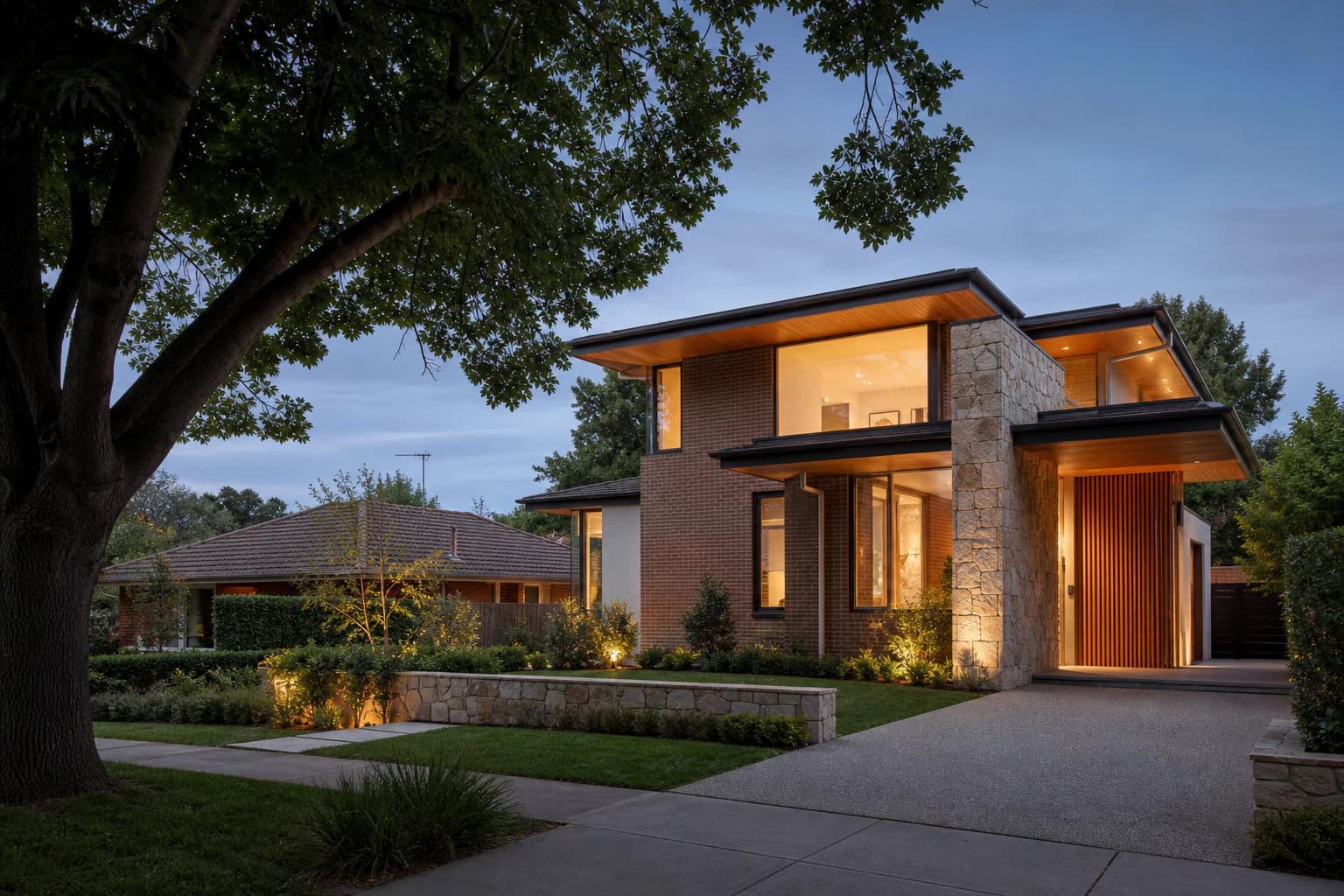
Custom Home Builder in Mulgrave
Mulgrave is a fully built-out suburb. Your block already has a house on it. NE Homes builds the one that should be there.
Mulgrave is where families stay. The house is the part that changes.
Mulgrave sits at the junction of Wellington Road and the Monash Freeway, within reach of the Glen Waverley school corridor and the Monash employment precinct. The suburb is fully established. There are no vacant lots, no display villages, no greenfield estates. Every block already has a home on it, typically a 1970s or 1980s brick veneer on 650 to 750 square metres.
You're not starting from scratch on raw land. You're making a decision about what to do with a block worth more than the house standing on it. For most Mulgrave owners, the answer is a knockdown rebuild, a custom home designed around the block they already own or a dual occupancy development that gets full use out of a standard-sized lot under City of Monash planning rules.
NE Homes builds all three. One custom home is on the books in Mulgrave now.
What Your Mulgrave Block Allows
Dual Occupancy in the City of Monash
Dual occupancy is well-established in the City of Monash. The council's planning scheme allows it, with a planning permit, on most standard residential lots. NE Homes has already built one in the council, The Meridian near Chadstone, and knows the permit pathway. If your block qualifies, we can tell you quickly and build both homes as your dual occupancy builder in Mulgrave.
Built for Established Blocks
Mulgrave blocks run mostly between 650 and 750 square metres, and almost every one already has a house on it, which makes a knockdown rebuild in Mulgrave the usual starting point. On a standard 700sqm lot there is room for a 40 to 50 square custom home, a double garage and a usable outdoor area. The same lot is often big enough for a dual occupancy, and on a corner block each home can face its own street.
Engineered for Clay Country
The City of Monash describes the soil across the municipality as clay-heavy, rating anywhere from Class S up to Class H1 or H2. Every new house needs a soil report for its building permit, and that report sets the class for your block. The engineer designs the slab and footings to it, so a highly reactive H1 or H2 site gets footings built for more ground movement than a slightly reactive Class S site.
Which Side of Mulgrave Your Block Is On
Most of Mulgrave is General Residential Zone Schedule 3, where a new home can reach three storeys and 11 metres. On the eastern side, which Monash treats as part of its Dandenong Valley escarpment areas,Neighbourhood Residential Zone Schedule 4 takes over and caps a house at 9 metres with no more than two storeys. A Vegetation Protection Overlay reaches into stretches of that eastern side as well, and it can bring in a permit to remove trees. Those limits apply to most home building in Mulgrave, so check the zone before you plan a third storey.
What Mulgrave Owners Ask Custom Home Builders
Can I build a dual occupancy on my Mulgrave block?
City of Monash permits dual occupancy on most standard residential lots, subject to setbacks, site coverage and existing vegetation. A standard Mulgrave block of 650 to 700 square metres often qualifies, depending on orientation, easement positions and what is currently on the site. There is no point discussing a dual occ design before a site analysis confirms the block is actually viable under Monash's residential provisions. That analysis is the first step.
We want to stay in Mulgrave for the schools and the area. Is rebuilding on our block realistic?
It is, and it is the most common reason we hear from Mulgrave owners. Families who chose this suburb for Wellington Secondary College, Mazenod College or proximity to the broader school corridor off Wellington Road do not want to start over somewhere else. A knockdown rebuild or custom home on your existing block keeps you in the suburb while giving you a house built around the way you actually live.
What can I build on a typical 700 square metre Mulgrave block?
On a 700sqm Mulgrave lot you have room for a 40 to 50 square custom home with a double garage, a private outdoor area and compliant setbacks on all boundaries. Two-storey works well on standard lots when you want to keep the outdoor footprint intact. Dual occupancy development is worth assessing on a lot this size too, and a corner allotment or a lot over 750sqm gives the design more room. The specific mix depends on orientation, existing buildings and any overlays, which is why we do a site analysis before any conversation about floor plans.
What does the City of Monash permit process look like for a custom home or dual occupancy?
A single new house on a standard Mulgrave lot normally proceeds on a building permit alone, with no planning permit. The zone requires a planning permit for one dwelling only on lots below 300 square metres. An overlay can still add one, and in Mulgrave that means the Vegetation Protection Overlay in the east or the Neighbourhood Character Overlay over Waverley Park. Clause 52.37, the canopy tree control, can also add one if a canopy tree has to come down. A dual occupancy needs a planning permit. If the design meets a set list of clause 55 standards and nothing else on the site needs a permit, it may qualify for VicSmart, where council does not advertise the application to neighbours. Subdivision into two separate titles runs through council and then Land Use Victoria, and the application can go in once the dual occupancy permit is issued. We handle every permit in that sequence under the build contract, and we talk to Monash planning before lodging when a proposal needs it.
What does the timeline from first call to slab look like?
From first conversation to slab down is typically 6 to 9 months, depending on design complexity and permit timeline. Without a planning permit in the mix, a single house usually sits toward the shorter end. Add a planning permit, for a dual occupancy or because an overlay applies, and the programme stretches, since that permit has to come through before the building permit. We run the site analysis and early design alongside the permit paperwork where we can to save time, and we walk you through the programme at the first meeting.
Tell us about your Mulgrave block
Building outside Monash? See custom home builder in Berwick or custom home builder in Balwyn.