
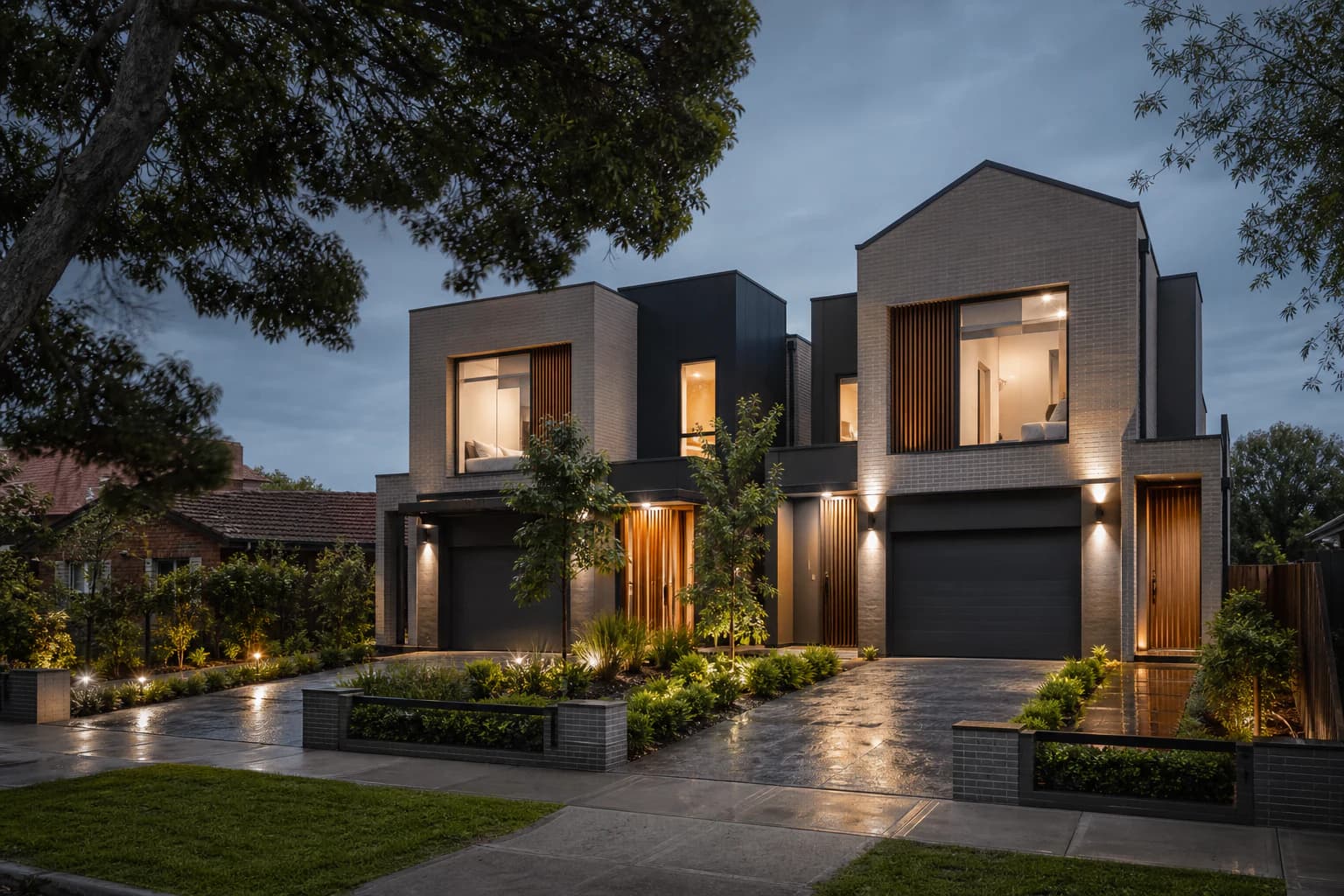
Dual Occupancy Builder in Mulgrave
A standard Mulgrave block can often hold two homes instead of one. Whether yours can comes down to the zone it sits in and what the City of Monash planning scheme allows. That is the first thing we check, before anyone talks about floor plans.
Two dwellings on a standard Monash block
Mulgrave's lots run 650 to 750 square metres, which is often enough land for two well-designed dwellings. The suburb sits in the City of Monash, and most of it is zoned General Residential, with objectives that protect the leafy garden character of streets like those off Wellington Road and Springvale Road. The east side is Neighbourhood Residential. Both zones allow two dwellings on a lot with a permit, so the question for your block is how the two fit.
Owners come to a dual occupancy from two directions. Some are downsizing: they build two, move into one and rent or sell the other to fund the project or their retirement. Others are investors developing the block for yield or resale. The design, the finance and the tax position differ between the two, so we start by asking which one you are.
NE Homes works as a home builder in Mulgrave and takes a dual occupancy from the first zone check through to two titles. We have done it in the same council before: The Meridian, our dual occupancy near Chadstone Shopping Centre, is in the City of Monash too. If a single custom home or a knockdown rebuild turns out to suit the block better, we will tell you that at the feasibility stage. Our Monash dual occupancy feasibility guide shows the numbers behind that call, and the developments service page lists what the contract covers.
Mulgrave's two residential zones, side by side
Neither zone caps how many dwellings a lot can hold.
| Rule | GRZ3, Garden City Suburbs | NRZ4, Dandenong Valley Escarpment Areas |
|---|---|---|
| Where in Mulgrave | Most of the suburb | The east side |
| Maximum height | 11 m and 3 storeys | 9 m and 2 storeys |
| Site coverage (clause 55 standard) | 65% | 60% |
| Garden area on a lot over 650 m² | 35% | 35% |
| Minimum lot size to subdivide | None | 300 m² per lot |
| Extra plans for a full permit | Existing trees, landscaping, materials and service areas | The same, with the landscape plan drawn by a landscape architect or qualified landscape designer |
Since September 2025 neither Monash schedule changes the state's setback, site coverage or open space figures. The only local figure is a 1.2 metre front fence. A Vegetation Protection Overlay also covers much of the east side and protects its larger trees.
- 1Garden area: 35% of a lot over 650 m², in both zones.
- 2Secluded open space: plan around 25 m² for each ground-level dwelling.
- 3Tree canopy: 10%, with a tree in both the front and rear setbacks.
- 4Site coverage: up to 65% in GRZ3 and 60% in NRZ4.
- 5Front fence: 1.2 m, the only local figure in either Monash schedule.
Schematic, not to scale. A two-dwelling layout on a Mulgrave lot over 650 square metres, drawn with the figures in the zone table above and the Clause 55 answer below.
How a Mulgrave dual occupancy gets approved and titled
VicSmart or a full permit
Since October 2025, a two-dwelling design that meets 13 listed clause 55 standards, such as street setback, site coverage and overlooking, qualifies for VicSmart, a quicker stream than a full application. Council checks the design against those standards, the garden area and the height limit, with no public notice to neighbours and no objector appeal. Removing more than one tree the Vegetation Protection Overlay protects, or breaching a registered restrictive covenant, rules VicSmart out.
Clause 55 is where dual occ is won or lost
Clause 55, which the state now calls the Townhouse and Low-Rise Code, covers setbacks, height, site coverage, tree canopy, private open space, overlooking and overshadowing. Since March 2025 a design that meets a standard is deemed to meet its objective. Meet every neighbourhood character standard and the daylight, overshadowing and overlooking standards that protect the neighbours, and objectors cannot take a full permit to VCAT.
One contract through to two titles
One contract covers feasibility, design, the City of Monash planning application, both dwellings and the subdivision through council and Land Use Victoria, with one director as your contact throughout.
From one title to two
Feasibility
Zone, title & block check
Design
Two dwellings to Clause 55
Planning Permit
VicSmart or full application
Build
Both dwellings, director-led
Subdivision
Two separate titles
Dual occupancy in Mulgrave: zoning, titles and cost
How do I know if my Mulgrave block is zoned for a dual occupancy?
Download a VicPlan planning property report on the block and look at the zone it names. Both General Residential and Neighbourhood Residential allow two dwellings with a permit and set no cap on dwelling numbers. Then check the title for a registered restrictive covenant, such as one limiting the land to a single house, because council cannot grant a permit that breaches it unless the covenant is also varied or removed. We check both before you spend anything on design.
Can I live in one dwelling and rent or sell the other?
Yes: you develop the block, move into the dwelling that suits you and rent or sell the second to fund the project. The dwelling you keep usually gets the better orientation and garden, and if you intend to sell the second separately, the subdivision has to be set up for it. We plan for that from the feasibility stage.
What does Clause 55 require, and where do dual occupancy applications usually get stuck?
Clause 55 sets measurable standards for setbacks, height, site coverage, tree canopy, open space and neighbour amenity, and applications stall on the ones a design misses. Each miss sends council to that objective's decision guidelines. A miss on one of the 13 VicSmart standards rules out VicSmart, and a missed neighbourhood character, daylight, overshadowing or overlooking standard lets objectors take a full permit to VCAT. On a Mulgrave lot over 650 square metres, plan around a 35% garden area, 25 square metres of secluded open space per ground-level dwelling and 10% tree canopy, with a tree in both the front and rear setbacks.
Will I get two separate titles, and does subdivision happen before or after the build?
Yes, and the subdivision application can go in before construction starts. Once the permit for the two dwellings is issued, a two-lot subdivision with one permitted dwelling on each lot qualifies for VicSmart as well. The block stays on one title until Land Use Victoria registers the plan of subdivision. NE Homes runs the subdivision within the same contract.
What does a dual occupancy in Monash cost to build compared with a single custom home?
A dual occupancy costs more than a single home because you are building two dwellings, but the cost per dwelling is usually lower than building each on its own, since site works, service connections and management are shared across the project. Whether the numbers work depends on your zone, your land value and whether you are keeping or selling. We run that feasibility before design, so you decide on figures worked out for your block.