
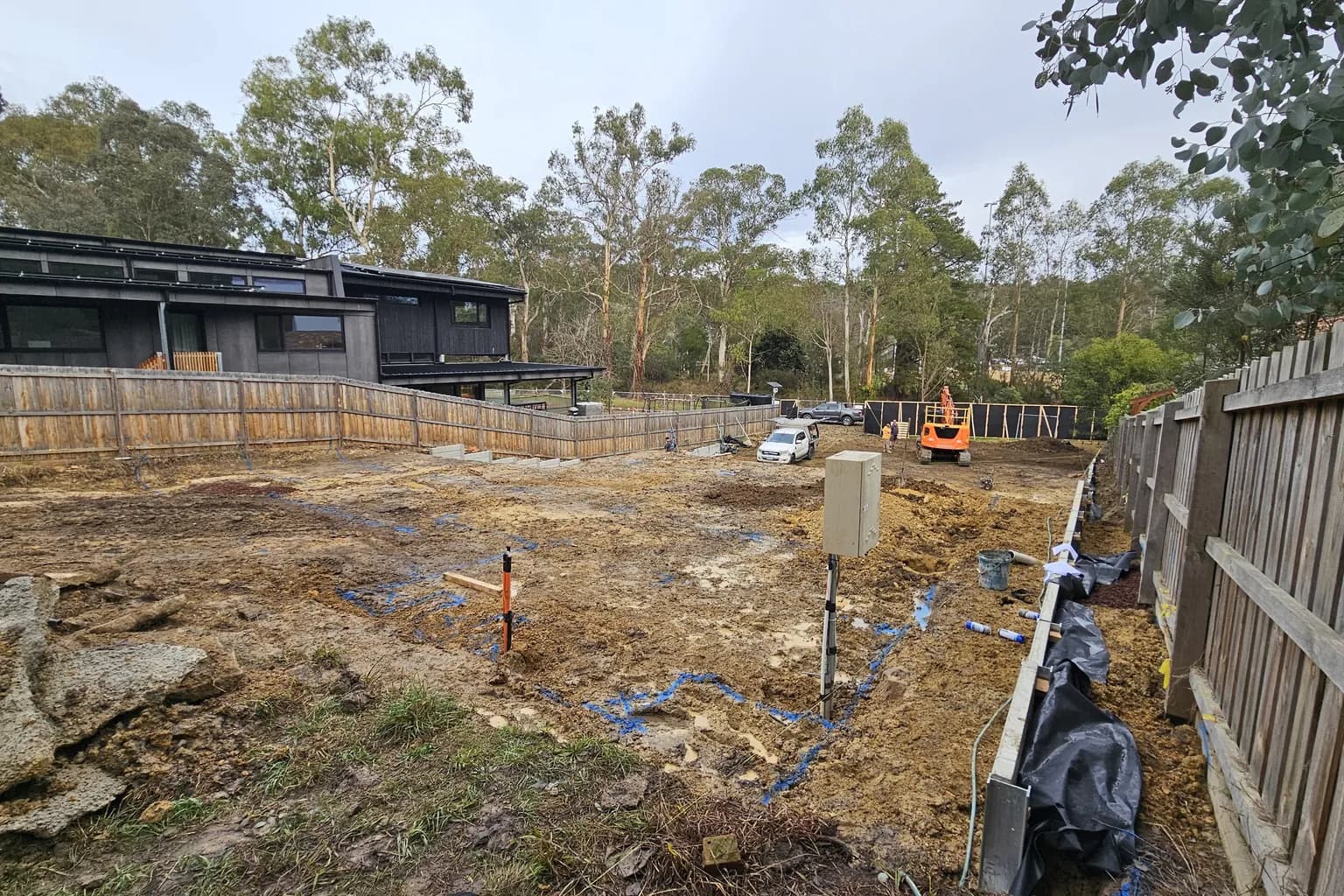
If you only do one check before buying a sloping block, make it the soil test. That is our director's advice from his own jobs. The report will not answer every question, but knowing the ground early lets us assess the likely building costs before you are committed to the land instead of after.
What a soil test tells you before you buy
A soil test (a geotechnical site investigation) classifies the block under AS 2870. It tells you how much the ground will move as it wets and dries and whether it falls into Class P. On a slope it also tells you what sits under the topsoil and how far down firm ground is. That shapes the footings and how hard the excavation will be.
The City of Monash singles out sloping land as a case where a full geotechnical report matters. A full report can cover the slab design, the quantity and type of stumps, contamination, the stability of the slope and any cracking already present. Our guide to sloping block site classification explains the classes once you have the result.
What the contract paperwork will not tell you
The vendor's statement, the section 32, is a long list of disclosures under the Sale of Land Act 1962: easements and covenants, the planning scheme with its zone and overlays, notices affecting the land, building permits issued in the last seven years and which services are connected. Soil is not on the list. Consumer Affairs Victoria's due diligence checklist raises soil contamination but says nothing about how reactive the ground is.
In our director's experience, what the ground holds is where a sloping block's costs move most, from manageable mudstone to hard rock close to the surface.
Getting the test done before you are committed
The simplest route is to test before you make an offer, with the vendor's permission for the engineer to access the site. If that is not practical, talk to your conveyancer or lawyer before you sign. In a private sale buyers can negotiate conditions. Consumer Affairs Victoria gives finance and a building or pest inspection as examples. Whether a soil-test condition can be included and how it should be worded is a question for them.
Do not rely on the cooling-off period to cover it. Under section 31 of the Sale of Land Act a buyer can end most private-sale contracts within three clear business days of signing, which is a short window to get a drilling rig on site. Cooling off does not apply to auction purchases at all. The exceptions also reach sales in the days either side of an advertised auction.
Who does it and what to ask for
A geotechnical engineer or engineering geologist. They decide how many bores the site needs and how deep to go. When you brief them, say the block slopes and ask for the site classification under AS 2870 and comment on slope stability. Send them the feature and level survey if you have one, so they can see the fall. Our guide to the feature and level survey explains what one shows.
If there is an old house on the block, the engineer can only drill in the open ground around it, so the result may need confirming after demolition. That is common on knockdown rebuilds on sloping blocks, where our director's reports often come back Class P.
What we do with the report
We read the detail rather than the letter. The class is a summary. The depths, the soil descriptions and any rock or fill noted in the bore logs are what shape the footings. With the report and a survey we can tell you what the ground means for the design. Our guide to building on a sloping block compares the design options. Send us the report on a block you are weighing up and we can talk through what it means for a sloping block build before you buy.
Frequently Asked Questions
Does the section 32 statement tell you the soil type?
No. The vendor's statement under the Sale of Land Act 1962 covers easements, covenants, the zone and overlays, notices affecting the land, recent building permits and services, but nothing about soil or site classification. You have to commission that information yourself.
Can I make my offer subject to a soil test?
Possibly, in a private sale, if the vendor agrees and your conveyancer or lawyer drafts the condition. Consumer Affairs Victoria does not list soil tests among its examples, so ask your conveyancer before you sign. Auction purchases have no cooling-off period.
Who does a soil test for building?
A geotechnical engineer or an engineering geologist. They drill bores on the block, log what they find and classify the site under AS 2870. The engineer decides how many bores the site needs. On sloping land the report can also cover the stability of the slope.
How much does a soil test cost?
It depends on the job the engineer is asked to do. Access for the drilling rig, the number and depth of bores, rock close to the surface, an existing house in the way and whether the report needs to cover slope stability all change the scope. Ask two or three geotechnical firms for a quote against the same brief.