
A protection work notice is the form you serve on your neighbour and your building surveyor when the surveyor has decided your building work needs protection work to keep the property next door from damage. The neighbour then has 14 days to agree, disagree or ask for more information. Saying nothing counts as agreeing. Excavation near a boundary is a common trigger, which is why the notice comes up so often on sloping blocks and knockdown rebuilds.
What counts as protection work?
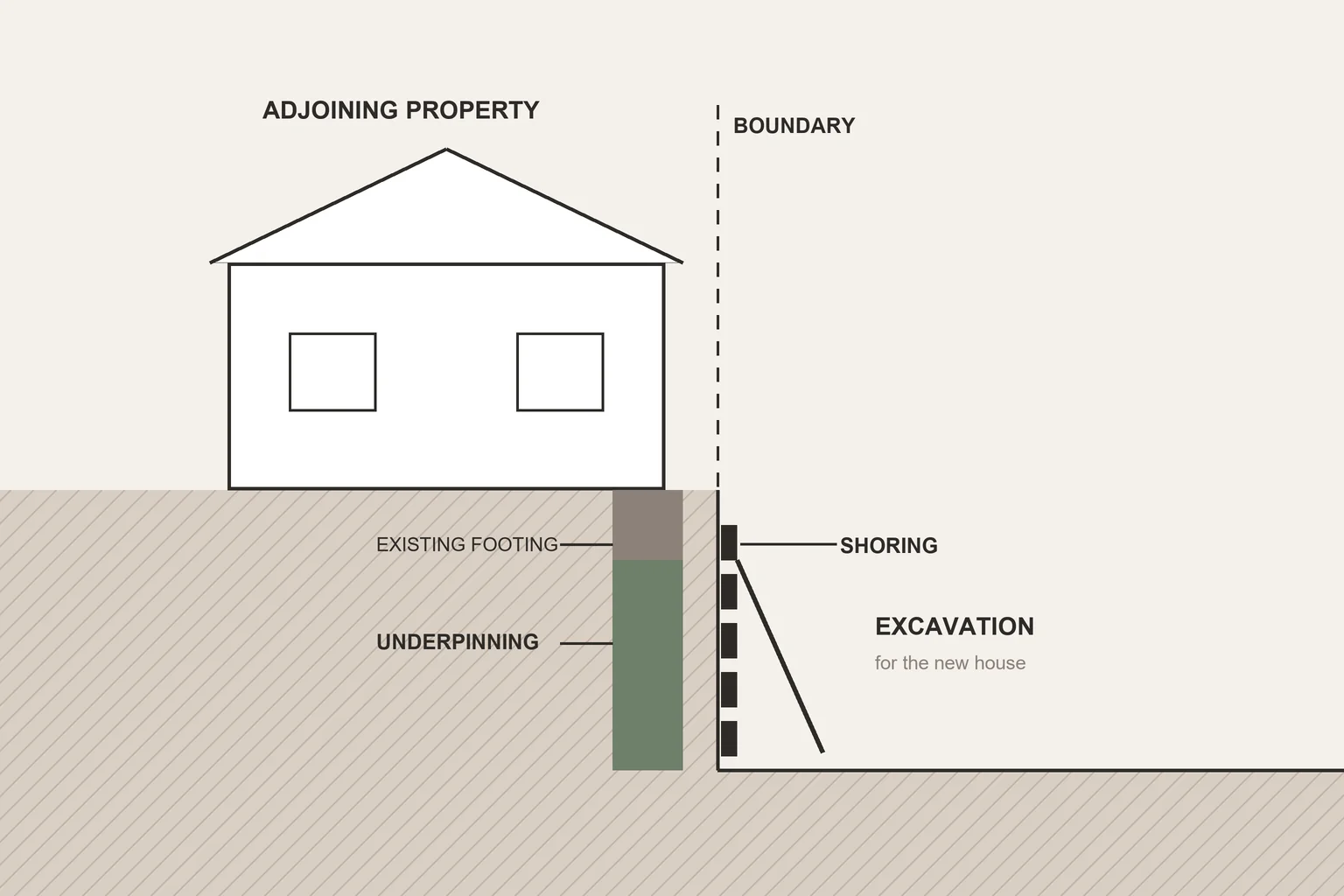
Work that keeps the adjoining property stable or protects it from damage caused by your build. Section 3 of the Building Act 1993 lists underpinning (vertical and lateral support, ground anchors and similar), shoring up the adjoining property, overhead protection and other work designed to maintain the neighbour's stability, whether it is temporary or permanent. The adjoining property can be a house, a street, a lane or a right of way, as long as it is at risk of significant damage from the building work.
When does the building surveyor require it?
The surveyor has to decide the question when assessing your building permit application. They can revisit it at any time after. Regulation 112 of the Building Regulations 2018 lists what they weigh: the allotment plan, demolition, excavation, work on party walls and retaining walls, the likely damage to the adjoining property and any engineer's certificates. The decision is recorded on Form 6 and sent to you within 7 days.
On a sloping block the trigger is usually the cut. A building platform dug into the high side of a lot sits right against the neighbour's ground. So does a retaining wall on the boundary. Knockdown rebuilds bring demolition and new footings close to walls the neighbour depends on.
What the building surveyor does
The surveyor makes the decisions in this process. They decide whether protection work is needed and receive a copy of your notice. If the neighbour disagrees or asks for more information, the surveyor examines the proposal and decides on it. The surveyor doesn't design or carry out the protection work. That is usually an engineer's design, built by the builder.
How the notice process runs
- The building surveyor determines that protection work is required, on Form 6.
- Before building work starts, you serve a Protection Work Notice (Form 7) on the adjoining owner and the surveyor. It goes with the Form 6 determination, three copies of the response form, the Commission's statement explaining the process, the plans and specifications of the building work and the protection work plus an allotment plan.
- The neighbour responds on Form 8 within 14 days: agree, disagree or request more information. No response within 14 days counts as agreement.
- If they disagree or ask for more, the surveyor examines the proposal and decides, on Form 9.
- The decision can be appealed to the Building Appeals Board within 14 days.
Section 88 of the Act stops the building work starting until there is agreement, deemed agreement or a determination. The Building and Plumbing Commission adds that a building permit may not be issued until the process is complete to the surveyor's approval. If you cannot find the neighbour's name and address, the Act now lets you ask council in writing for them.
What the owner owes the neighbour
- Insurance, before the protection work starts. Section 93 requires cover for damage to the adjoining property and for liability to adjoining occupiers and the public, during the work and for 12 months after it is finished. The Commission warns that a standard construction and public liability policy will not normally provide the minimum cover.
- A joint survey of the adjoining property before protection work starts, recording its existing cracks and defects, signed off by both owners. People often call it a dilapidation survey. The record can be used later as evidence of the property's condition.
- Access on notice. Entry is allowed between 8 am and 6 pm with at least 24 hours' notice, unless the owners agree something different.
- The neighbour's costs necessarily incurred in assessing the proposal and supervising the work, plus compensation for any inconvenience, loss or damage the protection work causes.
- As-built plans of the protection work, served on the neighbour and the surveyor within two months of finishing.
Who is responsible: the owner or the builder?
The Act puts these duties on the owner, meaning the owner of the land where the building work is being done. The notice, the bar on starting work, the insurance, the survey of the neighbour's property, the neighbour's costs and the as-built plans are all the owner's obligations. Where the Act sets a penalty, it falls on the owner.
That doesn't mean you do it all yourself. A builder can coordinate most of the process: the engineer's design of the protection work, the notice package, the survey and the work itself. The Act lets the owner's agent take part in the survey and enter the neighbour's property to carry out the work. Even so, the statutory obligations stay with you as the owner. Before you sign, check that your contract says who prepares and serves the notice, who arranges the insurance and who attends the survey.
On our builds we help coordinate the process for our clients. Before boundary demolition or significant excavation, we also arrange a dilapidation report, which records the condition of the neighbouring property before that work begins.
What has to be done before the work starts
Building work that gives rise to protection work can't start until the notice process is finished. The protection work itself has two more conditions. In order:
- The building surveyor has determined that protection work is required (Form 6).
- You have served the notice (Form 7) and its documents on the adjoining owner and the surveyor.
- The neighbour has agreed or is taken to have agreed after 14 days. Otherwise the surveyor or the Building Appeals Board has decided the matter.
- Insurance is in force and a copy has been lodged with the adjoining owner before any protection work starts.
- The survey of the adjoining property has been made with the neighbour or their agent. Before any protection work starts, its record of existing cracks and defects has been signed or acknowledged as agreed.
- The neighbour has had at least 24 hours' notice before anyone enters their property, unless you have agreed something different.
Building the notice period into a sloping block program
The notice cannot go out until the surveyor has the drawings to assess. The clock then runs from service, so time for it belongs in the program before the excavator is booked. On a sloping block the cut for the building platform can run deep beside a neighbouring house, which is the situation the diagram above shows.
A conversation with the neighbour before the paperwork arrives rarely hurts. Knockdown rebuilds on a fall raise the same issue, which our guide to knocking down and rebuilding on a sloping block covers. For the wider picture of building on a slope, start with our guide to building on a sloping block.
Frequently Asked Questions
Is protection work the owner's responsibility or the builder's?
The Building Act puts the duties on the owner of the land being built on: serving the notice, holding the insurance, making the survey of the neighbour's property and not starting until the process is complete. A builder can coordinate much of it. The Act also lets the owner's agent take part in the survey and enter the neighbour's property. The legal obligations still sit with the owner, so check your contract says who does what.
Can my neighbour stop me building by refusing a protection work notice?
No. A neighbour who disagrees sends that to you and the building surveyor, who then decides whether the proposed protection work is appropriate. That decision can be appealed to the Building Appeals Board within 14 days. Work cannot start until the process finishes, so a disagreement costs time. It is not a veto.
How long does a neighbour have to respond to a protection work notice?
14 days from service, under section 85 of the Building Act 1993. They can agree, disagree or ask for more information on the response form. If they do not respond in time they are taken to have agreed, with separate rules for an owner who is absent or unable to act.
Can a builder come onto my property to do protection work?
Yes, once the process is complete and they give notice. Section 95 allows entry between 8 am and 6 pm to carry out the agreed or determined protection work or the joint survey, after at least 24 hours' notice unless the owners agree otherwise. The adjoining owner must not refuse entry or obstruct the work after notice is given.
Who pays for protection work?
The owner doing the building work. That owner provides the protection work and holds the insurance the Act requires. They also pay the adjoining owner's costs necessarily incurred in assessing the proposal and supervising the work and compensate the adjoining owner for inconvenience, loss or damage the work causes. The amount of insurance is agreed between the two owners or set by the Building Appeals Board if they cannot agree.