
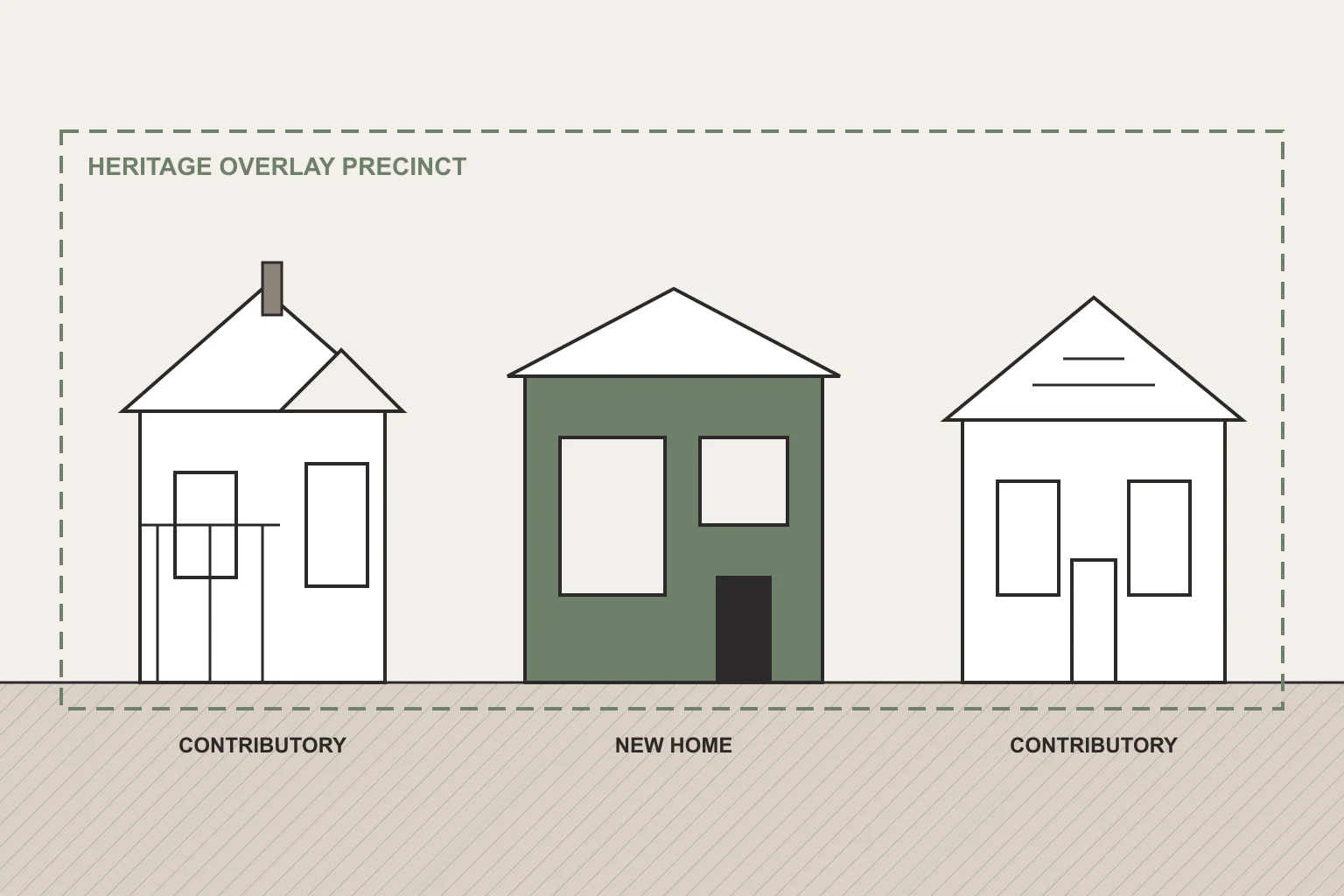
Sometimes. In a heritage overlay you need a planning permit from council to demolish a house, whatever its grading, as well as one to build its replacement. Whether council grants the demolition depends mostly on that grading. A non-contributory house in a precinct is the most likely to come down, while councils discourage demolishing significant and contributory houses and Boroondara's policy says it should not normally be allowed.
What a heritage overlay controls
Clause 43.01 of every Victorian planning scheme requires a permit to demolish or remove a building, to construct a building or carry out works and to alter the outside of a building by structural work, rendering or sandblasting. The works list reaches down to pergolas and verandahs, plus pools, fences, decks and rainwater tanks visible from a street or park.
Some controls only apply where the overlay's schedule switches them on for that property: external paint colours, internal alterations and trees. Painting a surface that has never been painted always needs a permit. Demolishing a house and building a new one are not exempt from notice, so those applications are usually advertised to neighbours.
Can you knock down a house in a heritage overlay?
You can apply, though council's answer turns on the house's grading. Boroondara describes significant places as individually important and contributory places as adding to a precinct's significance when combined with others. Non-contributory places have no heritage significance of their own. Glen Eira uses the same three tiers.
Non-contributory houses are the easiest case. Significant and contributory houses are much harder to remove. Each council in the growth market words its policy differently:
| Council | Non-contributory house | Significant or contributory house | Rules for the new home |
|---|---|---|---|
| Bayside (Brighton, Sandringham) | Policy allows demolition in heritage precincts | Discouraged unless structurally unsound or so deteriorated it needs substantial reconstruction, with a replacement showing design excellence | Streetscape montage, material and colour samples and a landscape plan with the application |
| Glen Eira (Bentleigh, Caulfield) | Policy is silent, though a permit is still required | Discouraged unless structurally unsound and not feasible to repair. A structural engineer's report must come with the application | No replica or mock heritage styles. Follow prevailing setbacks, height and roof pitch. Double garages only at the rear. Parking at least 1 metre behind the facade |
| Boroondara (Balwyn) | Policy supports demolition | Not normally allowed. Poor condition alone is no reason | Facade no higher or further forward than the heritage buildings beside it. No higher than their ridgeline from the street where the precinct height is consistent |
A permit is still required everywhere, whatever the grading. Council weighs whether the demolition will harm the significance of the place, reading the statement of significance for the property or precinct. It weighs the new home the same way, looking at its location, bulk, form and appearance next to the buildings around it.
Heritage overlay vs heritage listed
A heritage overlay is local and council decides it. The Victorian Heritage Register covers places of state significance and Heritage Victoria decides changes to them. If a place is on the Register, the heritage overlay's own permit trigger switches off for most development and the Heritage Act takes over. A building permit to demolish or alter a registered building then needs the consent of Heritage Victoria's Executive Director. Heritage Victoria notes that a planning permit may still be needed under other zone and overlay controls.
How to check whether your property is in a heritage overlay
- Download a planning property report for the address from VicPlan. It maps the overlays on the property and says whether it is on the Victorian Heritage Register.
- If a heritage overlay appears, note its number (HO followed by digits) and check the map to see whether the part of the block you want to build on sits inside it.
- Look the number up in the schedule to clause 43.01 of your council's planning scheme. The entry says whether paint, interior or tree controls apply and names the statement of significance.
- Find the grading. Glen Eira and Boroondara both publish heritage maps by address. In Glen Eira the table in the precinct's incorporated statement of significance takes precedence over council's map if the two disagree.
Buyers should know that a section 32 statement only has to name the overlay, not the grading or the statement of significance. Look those up before you sign.
Heritage overlays in Brighton, Bentleigh, Caulfield and Balwyn
In Bayside, Brighton has more than twenty heritage precincts in the planning scheme, among them Grosvenor Estate, Normanby Estate, Elm Grove and Hartley Street, plus hundreds of individually listed places. Brighton East has Berkeley Grove, Cheeseman Avenue and Palmer Avenue. The overlay isn't limited to Victorian and Federation houses either. Bayside added 50 post-war modern places in 2025 and seven mid-century houses in early 2026.
In Glen Eira, Bentleigh has three residential precincts: Bentleigh Residential, Bentleigh Heights Estate and Field Street. Caulfield North has several, including Caulfield North Estate and Environs and Park Crescent. Elsternwick has Gladstone Parade and Elsternwick Estate. Council heritage reviews for Caulfield North and for Caulfield South and Gardenvale were in progress in 2026 and propose new precincts and places.
In Boroondara, Balwyn has the Reid Estate and Gordon Street precincts. Balwyn North has the Riverside Estate and the Maud Street maisonettes, along with dozens of individually listed houses.
How long heritage approval takes
| Application | Statutory time | Neighbours notified |
|---|---|---|
| VicSmart: demolishing a garage, carport, shed or fence not named in the schedule or changing the outside of a non-contributory house | 10 business days | No |
| Planning permit to demolish a house and build a new one | 60 statutory days | Usually, so objectors can seek review |
| Council's section 29A consent before the demolition permit | 15 business days | No |
Requests for more information and the notice period affect when the 60-day clock runs. If council doesn't decide in time, you can apply to VCAT.
How heritage approval fits with the demolition permit
The planning permit comes first. Where a demolition takes more than half the house or any part of its street facade, section 29A of the Building Act requires council's report and consent before a demolition permit can issue. Council must refuse that consent while a required planning permit to demolish is missing. The building surveyor also needs a copy of the planning permit with the demolition application. So in a heritage overlay the order runs: planning permit, section 29A consent, then the demolition permit. The two permits answer different questions, which our planning permit and building permit guide sets out.
Designing a new home in a heritage precinct
Read the statement of significance before anyone draws. It says what council is protecting, which is what the design has to answer. Each council's rules for the new home are in the table above. In a precinct the questions keep coming back to how the house sits beside its heritage neighbours: setback, height, roof form and where the car goes.
A heritage project doesn't have to mean demolishing everything. It can mean keeping particular parts of the building and adapting the new work around them. On one of our projects in Albert Park, the front facade and a fireplace had to be retained, so the design was worked around those protected elements rather than starting from a cleared block.
Heritage applications usually ask for more paperwork than a standard house: a written response to the heritage policy, a streetscape photo montage and, in Bayside, material and colour samples with a landscape plan. That time belongs in the program from the start.
Planning a knockdown rebuild in a heritage overlay
Start with the planning property report and the statement of significance, because they decide whether a rebuild is realistic before any money goes into design. From there the usual early steps apply, which our knockdown rebuild process guide walks through, along with the planning rules to check before you design. Council also wants an asset protection permit before demolition starts. If your block is on a heritage street in Bayside, Glen Eira or Boroondara, talk to us about our knockdown rebuild service before any design work starts.
Frequently Asked Questions
Can a non-contributory house in a heritage overlay be demolished without a permit?
No. Clause 43.01 requires a planning permit to demolish or remove any building in a heritage overlay, whatever its grading. What changes with a non-contributory house is council's attitude to the application: Bayside and Boroondara policy supports or allows demolishing non-contributory buildings in a precinct. The new house still has to suit the precinct.
What is the difference between a heritage overlay and being heritage listed?
A heritage overlay is local. It sits in the council's planning scheme and council decides permits under it. The Victorian Heritage Register is state level. Changes to a place on the Register need a permit from Heritage Victoria. A building permit to demolish or alter a registered building also needs the consent of Heritage Victoria's Executive Director.
Can a heritage overlay be added to my property after I buy it?
Yes. Councils add overlays through planning scheme amendments. They can also ask the Planning Minister for an interim overlay while a place is assessed. Under section 29B of the Building Act, a demolition permit can be put on hold while that request is made. Glen Eira and Boroondara both have heritage reviews in progress in 2026.
Do I need a permit to paint a house in a heritage overlay?
Only where the overlay's schedule turns on external paint controls for that place, with one exception: painting a surface that has never been painted always needs a permit. The schedule entry for the property tells you which controls apply.