
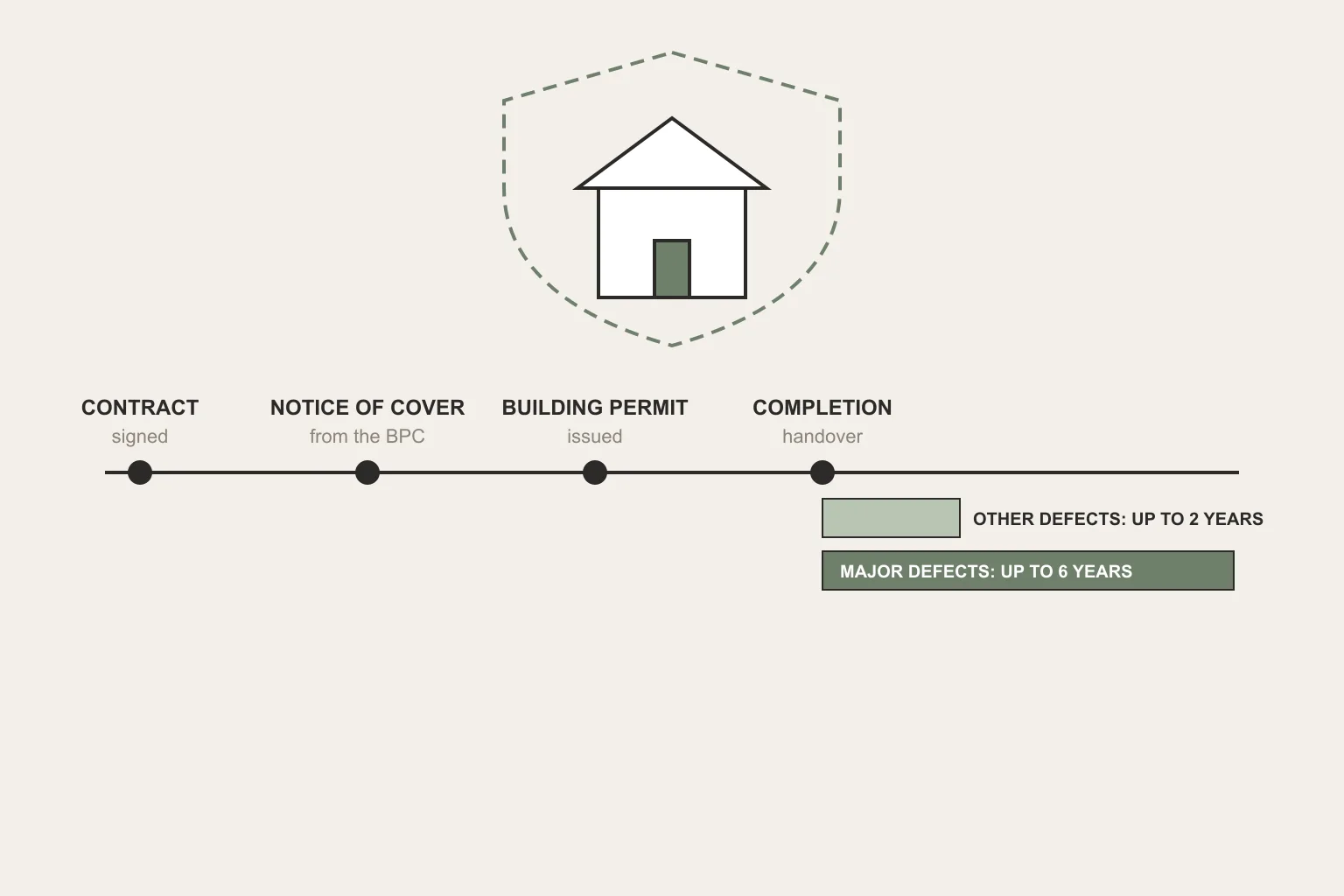
Home Warranty is the insurance behind a new home build in Victoria. It replaced Domestic Building Insurance (DBI) for eligible contracts signed on or after 1 July 2026. It comes from the Building and Plumbing Commission (BPC), the state building regulator, rather than a private insurer. The biggest change is when it helps: you can claim when work is incomplete or defective and the builder can't or won't fix it, without waiting for the builder to die, disappear or go broke.
Has Home Warranty replaced Domestic Building Insurance?
Yes, for contracts signed on or after 1 July 2026. The date you sign the building contract decides which scheme you are under, not the date of the building permit. Contracts signed before then stay with DBI, whose policies continue under the old scheme. DBI cover does not transfer to Home Warranty.
Home Warranty applies to domestic building work worth more than $20,000 on homes and other residential buildings of up to three storeys. The scheme excludes apartment buildings. The law behind it is the Building Legislation Amendment (Buyer Protections) Act 2025, which added a statutory insurance scheme to the Building Act 1993.
Most of the pages that still rank for domestic building insurance describe the old scheme. Here is how the two compare:
| Domestic Building Insurance | Home Warranty | |
|---|---|---|
| Contracts signed | Before 1 July 2026 | On or after 1 July 2026 |
| Required for work worth | More than $16,000 | More than $20,000 |
| When you can claim | The builder has died, disappeared or become insolvent | Work is incomplete, defective or non-compliant and the builder can't or won't fix it |
| Maximum cover | Generally up to $300,000 | Up to $400,000 in total per home |
| Incomplete work | Up to 20% of the contract price | Up to 30% of the contract price, including agreed variations |
| Defect periods | 6 years for structural defects, 2 years for others | 6 years for major defects (including waterproofing and weatherproofing), 2 years for others |
| Document you receive | Certificate of insurance | Notice of Cover |
| How a later buyer checks | The BPC's DBI search tool | An Insurance Information Statement from the BPC |
What home warranty insurance covers
It can help when work is incomplete, defective or non-compliant and the builder is unable or unwilling to complete or fix it, within the cover periods and limits below. It is not a promise that every defect will be paid for. Related help the BPC lists includes lost deposits where work has not started and securing an incomplete site. It can also cover accommodation, removal and storage costs while work is fixed.
Inside the overall cap, some kinds of help have their own limits. Incomplete work, for example, is capped at 30% of the total contract price including agreed variations.
It does not cover minor cosmetic differences, fair wear and tear, vandalism or theft, defects caused by missed maintenance or work outside the contract. It also won't protect you if you use an unregistered builder for work that needs a registered one.
When you can make a claim
Earlier than you could under DBI, though your builder still gets the first chance to fix things. If the builder is still trading, you will usually need to give them a written complaint notice first. They then have 28 days to respond before the BPC assesses your claim. The BPC must also consider ordering the builder to fix the work before it decides. You can skip the complaint notice if the builder has died, disappeared, become insolvent or had their registration cancelled by the BPC. The same applies if the contract has been validly ended because the builder defaulted.
Time limits apply. For defects, the BPC asks you to claim within 12 months of becoming aware of the problem or of when you reasonably should have. Separately, the BPC can now order a builder to fix defective work for up to 10 years after completion, including work finished before the new rules started.
Who pays for it and when
Your builder pays the premium on your behalf. The deadline is 10 business days after the contract is signed or the day work starts if that comes sooner. Work counts as started once tools or materials are first used on site. Failing to pay is an offence for the builder. If a variation adds more than $5,000 to eligible work, the builder must pay an additional premium. You are still protected if the builder doesn't pay, provided the work is eligible and the scheme requirements are met.
Once the premium is paid, the BPC sends you a Notice of Cover. Check that the builder's name, registration number, the site address and the work described match your contract. If anything doesn't, contact the BPC. The notice matters for your permit too: the building surveyor can't issue the building permit until a Notice of Cover has been issued for the work. Our guide to the difference between a planning permit and a building permit explains where the building permit sits in the sequence.
Premiums and cover: what you get for the cost
Insurance for a new home got much dearer before Home Warranty began. The Victorian Auditor-General reports that the state insurer raised Domestic Building Insurance premiums by 43% in 2023, then by 65% for single-dwelling policies in July 2024. The government put those rises down to higher building costs and more claims after major builders collapsed.
Home Warranty premiums are set by the BPC, mainly on the contract value and the type of work, so a larger build carries a larger premium. No government source has yet compared Home Warranty premiums with the old DBI premiums.
The cover is broader. You can claim while the builder is still trading. Help with incomplete work goes up to 30% of the contract price instead of 20%. The maximum rose from $300,000 to $400,000 per home, but part of that rise keeps pace with costs: the government's case for the higher limit was that building a house costs far more than it did in 2014, when the old limit was set. A deductible also applies when you make a claim. It is higher for claims made later in the cover period.
What to check before you sign a building contract
- Look the builder up on the BPC's practitioner search, by name or registration number. Check its compliance and enforcement register too. The BPC's own advice is not to rely on advertising, business cards or quotes.
- Confirm the work is eligible for Home Warranty.
- Ask when the premium will be paid and when you should receive the Notice of Cover.
- Keep the contract, the Notice of Cover and your correspondence together.
The contract is the other half of your protection: our comparison of fixed-price and cost-plus contracts sets out what Victorian law requires it to include.
Buying a home that was built recently
Ask the BPC for an Insurance Information Statement. It shows whether a Notice of Cover was issued for Home Warranty work at the property on or after 1 July 2026, when that cover ends and the maximum cover. For work insured before then, the BPC's search tool confirms whether DBI was issued.
How we handle the deposit, payments and cover
We know confidence in the building industry has taken a hit. ASIC counted 992 Victorian construction industry companies entering external administration or having a controller appointed for the first time in the 2025-26 financial year, after 1,051 in 2024-25. Those figures include trades and commercial firms as well as home builders. A new home is a big commitment. Clear payment arrangements and paperwork are how we try to make it a more comfortable one.
- Our deposit is 5%. We only issue the deposit invoice once the contract is signed, your finance is approved, the documents are finalised and we are ready to go to site.
- The Home Warranty premium follows the timetable the law sets: within 10 business days of signing the contract or before work starts, whichever comes first. The BPC then sends you the Notice of Cover for your project. Your building permit can't be issued without it. We make sure you have it promptly and understand what it covers.
- Our progress payment schedule is tailored to each project. Each invoice is for a completed contractual stage. We aim to keep each stage invoice to a moderate amount, including on larger projects, to limit how much you have riding on any one payment.
Moderate stage invoices limit your exposure to any one payment. They don't mean each stage is separately insured. Home Warranty's cap is $400,000 in total for the home across every kind of claim. Help with incomplete work is capped at 30% of the contract price. A claim also depends on the builder being unable or unwilling to complete or fix the work, inside the exclusions and time limits above.
Why this matters to us
NE Homes is a registered builder, registration number CDB-U 62725. As the law requires, we pay the Home Warranty premium on eligible jobs. After Porter Davis collapsed in 2023, we took over a home it had left two-thirds finished and delivered it by Halloween that year. Check us on the BPC register, then read how our custom home builds run or send an enquiry.
Frequently Asked Questions
Who pays for home warranty insurance in Victoria?
The registered builder. The builder pays the Home Warranty premium to the Building and Plumbing Commission on your behalf, within 10 business days of signing the contract or before work starts if that comes first. The BPC notes the cost may be reflected in your contract price, so ask whether it is included in the price you are signing.
How much does home warranty insurance cover?
Up to $400,000 in total per home, the maximum the BPC publishes for Home Warranty. That is one limit for the whole home, not a separate amount for each stage of the build. Some kinds of help have their own limits inside that total, such as incomplete work, which is capped at 30% of the contract price. Major defects can be covered for up to six years after completion and other defects for up to two.
What if my building contract was signed before 1 July 2026?
Then Domestic Building Insurance applies, not Home Warranty. DBI is the older last-resort cover for when a builder has died, disappeared or become insolvent. Existing DBI policies carry on under the old scheme. DBI cover does not transfer to Home Warranty.
Does Home Warranty cover owner-builders?
Not for their own project. A person who needs an owner-builder certificate of consent for the work isn't entitled to Home Warranty assistance for that work. Different rules apply when an owner-built home is sold. The BPC is the place to check them.