
Victoria restricts gas in new homes through two separate pieces of law. They were made almost two years apart, they catch different houses and only one is in operation yet. For anyone building in Melbourne, the difference decides whether an all-electric home is a choice or a requirement. Most coverage flattens them into a single ban, which is how a client ends up either worrying about a rule that never touched their block or relying on a window that is closing.
On a custom home that difference has to be settled early. Whether the house connects to gas decides what your kitchen brief can contain, what goes against the side wall and how much of the roof stays clear.
What an all-electric home actually is
Every fixed system in the house runs on electricity: hot water, space heating and cooling, cooking and anything else that would once have burned gas. On a new build what matters is the absence of the connection itself. There is no meter on the boundary and no service in from the street, so nothing gets run through the slab or the wall cavities before plaster goes on. A gas line is not something a finished house grows later without being opened up.
A knockdown rebuild lands in the same position despite appearances. The old house may have had a gas service into it for forty years, but the code treats the replacement as a new dwelling in its own right with its services drawn from scratch. Whatever fed the building you demolished carries no weight.
Two rules, two dates and which one reaches your house
The planning rule, in force since 1 January 2024
Amendment VC250 was gazetted on 1 January 2024 and introduced Clause 53.03 into Victoria's planning schemes. It prevents a planning permit being granted to connect a new dwelling, apartment development or residential subdivision to reticulated natural gas. The clause also imposes a mandatory permit condition, so nobody adds a connection once the development is finished. The rule applies to applications lodged on or after that date.
Scope is the part almost everyone gets wrong. Clause 53.03 only reaches new dwellings that require a planning permit. Building a new house, an outbuilding or a pool that does not need one falls outside it entirely, as does extending an existing dwelling or converting a garage into one. Whether a detached home or a rebuild triggers a planning permit depends on the zone, the overlays and the lot, so it is a question for your site and not one anyone can answer in general.
Since 2024 some new Melbourne homes have been unable to connect to gas while others a few streets away could. Victoria publishes its own explanation through Planning Victoria.
The building rule, from 1 January 2027
The Building and Plumbing Amendment Regulations 2025 (S.R. No. 140/2025) were made on 9 December 2025 and come into operation on 1 January 2027. From that date a relevant building surveyor must not issue a building permit where the surveyor is aware that a new connection of reticulated gas relates to the building work. A parallel provision in the Plumbing Regulations prohibits the plumbing work that would connect a reticulated gas appliance during construction of the building.
Because that rule bites at building permit stage, it does not care whether a planning permit was ever needed, so it reaches new homes generally. The Victorian Government's electrification standards page sets out the phase-in.
Both rules deal with reticulated gas. Bottled LPG falls outside either of them.
If you are designing now, the date on your permit matters
The 2027 regulations carry an exemption for building work to which section 10(1) or 10(2) of the Building Act 1993 applied immediately before 1 January 2027. In practice that covers work with a building permit already issued or a design the relevant building surveyor certifies had made substantial progress before the regulations commenced.
Pre-construction on a custom home runs around six months from first meeting to permit where no council planning approval is involved, longer where a planning permit is required. A design starting now falls on one side of that date or the other. The custom home build process shows where the energy assessment and the permit application fall in that sequence.
Design the house all-electric whichever side of the line your permit falls on. A home built under a transitional provision still has to be lived in, sold and re-serviced under rules that are only moving one way.
Why fuel choice also became a compliance question
NCC 2022 introduced a whole-of-home energy budget alongside the 7-star envelope minimum, both mandatory in Victoria from 1 May 2024. The budget covers fixed appliances: heating and cooling, hot water, lighting as well as pool and spa pumps. A home has to keep its total energy use inside that budget and on-site solar can offset the remainder. Our guide to 7-star NatHERS ratings covers how both get assessed.
The star rating measures the thermal envelope and nothing else, so electrifying a home does not move it. Swapping a ducted gas heater for a reverse cycle system changes what the budget sees, not what the stars say.
Hot water: the decision that moves the number most
Nothing in Victorian law requires a heat pump. From 2027 a new home cannot have a reticulated gas water heater and any water heater that is not reticulated gas satisfies that. The whole-of-home budget charges in a different currency: a weak hot water selection consumes budget you have to win back through the envelope or through solar.
A hot water unit occupies real space on a real elevation, which is where a one-off home parts company with a display home. Working from a custom plan means answering questions the catalogue never asks:
- Where the unit physically sits and what that does to the elevation behind it
- How far it sits from the wet areas it serves, since pipe run is heat loss
- What it sounds like from the nearest bedroom window. A heat pump has a compressor and a narrow side courtyard with hard surfaces will give it back to you.
- What the slab or the pad needs underneath it, where the condensate goes and what the switchboard has to carry
At concept each of those is a five minute conversation. Leave them and they become compromises negotiated around a hardened floor plan.
Heating and cooling in Melbourne, where winter does the work
Berwick and most of Melbourne's south east fall in NatHERS Climate Zone 6, classified Cool Temperate. A house here spends its energy getting through winter. Cooling is a genuine requirement without being the thing that sizes the system.
Reverse cycle is the practical replacement for ducted gas heating in a new all-electric home. No rule mandates it. Inside the whole-of-home budget what counts is the efficiency of the unit you actually install, not the fuel on its own.
Heating and cooling argues hardest with the architecture, which is why its consequences arrive early. Ducted runs need roof space and compete with the truss design. A ceiling cavity carrying ducts to the far end of a long single-storey plan produces bulkheads someone has to draw. The outdoor unit needs a position that suits the neighbour's boundary and your bedroom windows at once.
The kitchen question and what it is really about
Cooking does not appear on the list of fixed appliances the whole-of-home budget covers, so nobody should tell you an induction cooktop helps your home pass an energy assessment.
What the cooktop does change is your services layout. From 2027 a new home cannot take a new reticulated gas connection, so a reticulated gas cooktop has nothing to connect to. LPG remains lawful and falls outside the prohibition.
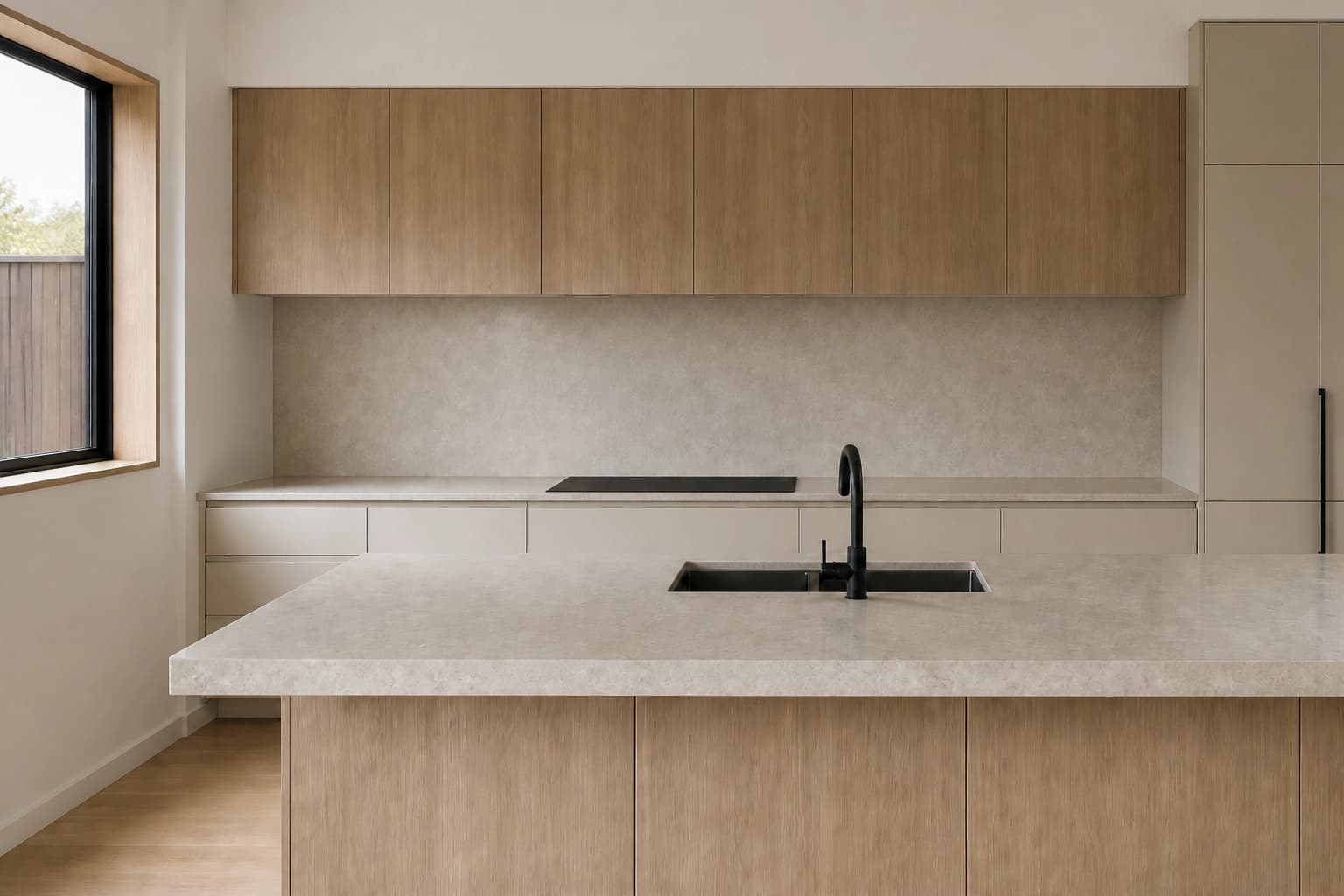
So a kitchen brief written around a gas cooktop needs revisiting while the kitchen is still on paper. Induction changes the circuit and the switchboard allowance, the clearance and drawer layout under the bench, the ventilation strategy and, for some cooks, the cookware. All of it is the client's call and all of it gets expensive once joinery has been drawn.
Designing for solar without installing it yet
Rooftop solar is not mandatory in Victoria. It is one of several ways to meet the whole-of-home budget, since on-site generation offsets whatever is left once the fixed appliances are counted.
On a one-off home the option stays open for very little, provided somebody asks while the roof is still being drawn:
- Keep one roof plane large, uninterrupted and pointed the right way. Flues, vents, aerials and skylights take bites out of it wherever the plan puts them.
- Settle the pitch with the roof form, because it stops being adjustable the moment the trusses are fabricated.
- Run conduit from the roof space to the switchboard during rough-in, while the walls are still open.
- Leave physical room at the board and specify a meter panel that is not already full on handover day.
Eligible households building a new home may be able to claim the Solar Homes solar panel rebate through Solar Victoria, which is open to the owner of a home under construction. Check current eligibility with them directly. Most other Victorian electrification incentives are retrofit instruments built around removing an existing gas appliance, so a new build has nothing to remove and does not qualify.
What to settle at design stage and what can wait
Settle before working drawings are finished:
- Whether the house connects to gas and what that does to your permit path
- The hot water system type and its physical position on the plan
- The heating and cooling system and the roof space, bulkheads or outdoor unit position it needs
- The cooktop, because it drives joinery and circuits
- Switchboard capacity and position, with room left to grow
- The roof plane and the conduit you want kept available for solar
Safe to leave until later:
- The solar array itself
- Specific appliance brands and models within the type specified
- A car charging point, provided the conduit or the circuit gets run now
Building an all-electric home with NE Homes
NE Homes settles services and fuel decisions at concept stage alongside the plan, because on a one-off home they carry physical consequences for the elevation, the joinery, the roof and the switchboard. Our director runs every project from first site visit to handover under one contract, so where the hot water unit goes gets answered by the person who will be standing there when it goes in.
Our custom home service runs from design to handover, with every project engineered for the block it is actually going on. Anyone building in Melbourne's south east should work out what the 2027 date does to their permit path before settling on a plan. That is the first conversation to have with us.
Frequently Asked Questions
What is an all-electric home?
An all-electric home runs every fixed system on electricity and has no gas connected to it. That covers hot water, space heating and cooling, cooking and anything else that would otherwise burn gas. On a new build the defining feature is the absence of a gas connection to the property, which means no meter, no service from the street and no gas line run through the building fabric.
Does a new home in Victoria have to be all-electric?
From 1 January 2027, yes, in the sense that matters. The Building and Plumbing Amendment Regulations 2025 were made on 9 December 2025 and commence on 1 January 2027. From that date a relevant building surveyor must not issue a building permit where the surveyor is aware that a new reticulated gas connection relates to the building work. Before then, a narrower rule already applies: since 1 January 2024, Clause 53.03 has prevented a planning permit being granted for a new dwelling connecting to reticulated natural gas, but only where a planning permit is required in the first place. Many detached homes do not require one. Whether yours does depends on your zone, your overlays and your lot. Both rules deal with reticulated gas rather than bottled LPG. Your building surveyor is the person who confirms what applies to your permit.
What does the whole-of-home energy budget cover?
It covers fixed appliances: heating and cooling, hot water, lighting as well as pool and spa pumps. A home has to keep its total energy use within a budget calculated for it and on-site solar can offset the remainder. It runs alongside the 7-star NatHERS rating, which measures the thermal performance of the building shell and does not assess appliances at all. Cooking does not appear on the list of appliances the budget covers.
Can you still have a gas cooktop in a new custom home?
From 1 January 2027 a new home cannot take a new reticulated gas connection, so a reticulated gas cooktop is not available to it. Bottled LPG is not covered by the prohibition. Before that date, whether a reticulated gas connection is possible depends on whether the project needs a planning permit, since Clause 53.03 has applied to new dwellings requiring one since 1 January 2024. None of this comes from a rule about cooktops specifically. Cooking does not appear on the list of appliances the whole-of-home energy budget covers. Your building surveyor confirms what applies to your permit.
Should a new home be designed for solar even if solar is not installed yet?
Yes, because the provisions cost almost nothing while the roof is being drawn and a great deal afterwards. Keep one roof plane large, uninterrupted and correctly oriented, settle the pitch with the roof form, run conduit from the roof space to the switchboard during rough-in and leave capacity at the board. Rooftop solar is not mandatory in Victoria, though it is one of the ways a home can meet the whole-of-home energy budget, so leaving the path open protects a decision you may want to make later.