
The legal point of discharge (LPOD) is the spot where council says the stormwater from your block has to leave it and enter council's drains. On a flat block it is usually a formality. On a block that falls away from the street it can decide how deep the drains go, where the house sits and whether you need to talk to the neighbour behind you before anything is built.
What is a legal point of discharge?
Regulation 133 of the Building Regulations 2018 requires a building permit application that includes a stormwater drainage system to obtain "the report of the relevant council" showing where the point of discharge sits, either within the lot or at its boundary. The surveyor then approves the design only if it discharges at that point.
The City of Monash describes the point as "usually the lowest point on the property". Cardinia Shire lists the usual options: a council drain in an easement on the property, a drain in the street, the kerb and channel or an open earth drain beside the lot. Queensland calls the same idea a lawful point of discharge, which is why both terms turn up when you search.
How to get the LPOD report for your property
You apply to the council online. Each council names the product slightly differently. The City of Casey issues a Legal Point of Discharge Report, which gives the size, depth and offset of the council drains inside your boundary. Casey says it usually takes about 10 working days and that its drain details are a guide rather than a record of what was built. Monash quotes about 10 business days. All three councils charge a fee for it.
Three things catch owners out:
- The report covers council's drains, not yours. Casey says plainly that it does not show downpipes or the drainage inside the property. It sends you to a plumber for those.
- Cardinia will not provide LPOD information until the title for the lot has been released, which matters on a new estate block.
- Casey publishes its discharge points as open data. It is useful for a first look at a block you are thinking of buying, but the building surveyor relies on the council report.
Why a block that falls away from the street is harder
Stormwater runs downhill and the pipes that carry it have to fall too. When the council drain sits in the street at the high side of the block, water collected at the back of the house is lower than the point it has to reach. When the drain sits in an easement at the low side, the design is simpler, but the house has to keep clear of it unless the authority consents.
On a downhill block the civil engineer and the plumber design how the water gets from the low point to council's point. Sometimes the natural route runs through the property below. That is an arrangement between you and your neighbour for a lawyer to set up. Section 16 of the Water Act 1989 makes an owner liable where water flows from their land onto other land unreasonably and causes damage, so the design has to control where it goes.
A slope also tends to put a council drain where you want the house. Under regulation 130, a permit to build over an easement held by a service authority needs that authority's report and consent. The Water Act separately bars building over a drainage easement without consent. Cardinia goes further and asks for approval for any building or works within one metre of a council drain, even where no easement appears on the title.
Who designs and installs the drains
A licensed plumber. The Plumbing Regulations 2018 treat the below-ground stormwater system, from the downpipes to the point of discharge, as drainage work. Only a licensed or registered plumber can carry it out (Building Act 1993 s221D). The Plumbing Regulations require the work to meet the Plumbing Code of Australia. On a sloping block the civil engineer usually sets the levels and the plumber documents and installs the system to them. The site plan in the building permit application shows the levels of the lot, the floors and the street drain, plus the layout of drains to the point of discharge.
How we handle the discharge point on a sloping block
Get the council report before design starts rather than at building permit stage. When the discharge point and any easement sit on the feature and level survey alongside the contours, the first sketch already shows where the water has to go. On a downhill block that sometimes moves the house forward, lifts the rear floor or turns a flat pad into a split-level or raised floor design.
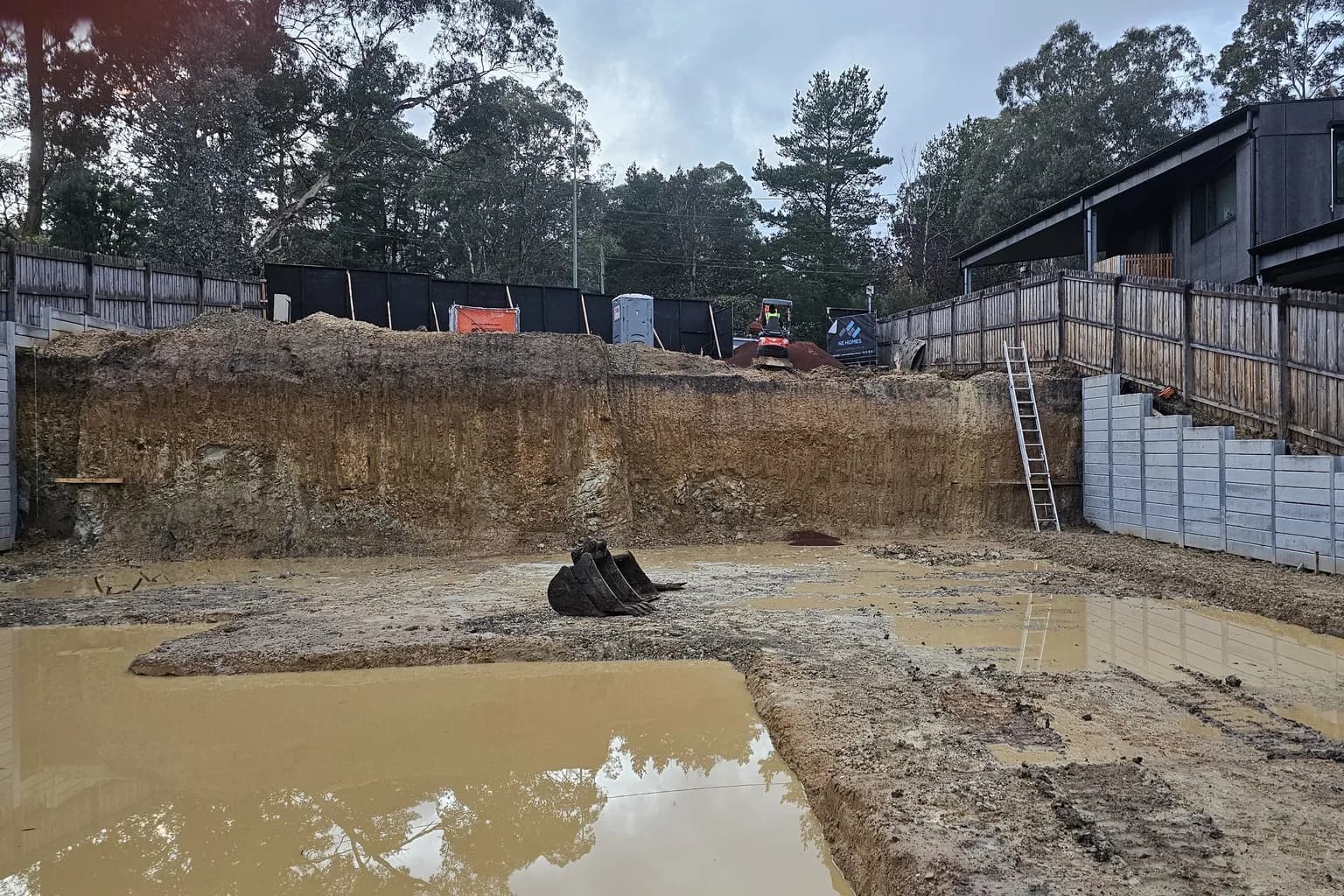
Project Arcadia in Warrandyte falls away from the street, with a pool and several balcony levels cut into the slope. The excavated platform pictured above holds a pond after rain, which is why the water plan has to be settled before the slab. If you are looking at a block that falls away from the street, ask where the discharge point is before you commit to a design. Our page on sloping block builds explains how we assess a slope.
Frequently Asked Questions
What does legal point of discharge mean?
It is the point council nominates for the stormwater from your property to leave it and enter council's drainage system. That is usually a council drain in an easement on the lot, a drain in the street, the kerb and channel or an open drain beside the property. Under regulation 133 of the Building Regulations 2018, your building surveyor can only approve a stormwater design that matches council's report on that point.
How long does a legal point of discharge report take?
About 10 working days at the City of Casey and about 10 business days at the City of Monash, going by their own application pages. Both charge a fee. Cardinia Shire will not issue the information until the title for the lot has been released.
Do I need a legal point of discharge for a knockdown rebuild?
Yes, when the new house includes a stormwater drainage system, which almost every new house does. The building permit application has to include council's report on the point of discharge, whether the old house drained there or not. The existing drains on the lot are not included in that report.
Can my stormwater run onto my neighbour's land?
Not in a way that is unreasonable and causes damage. Section 16 of the Water Act 1989 makes the owner liable where a flow of water from their land onto other land is unreasonable and causes injury, damage or loss. The City of Casey treats water running between neighbouring properties as a civil matter and points owners to the Dispute Settlement Centre of Victoria. If your design needs to cross a neighbour's land, get legal advice on the arrangement.